Chamber Music Concert
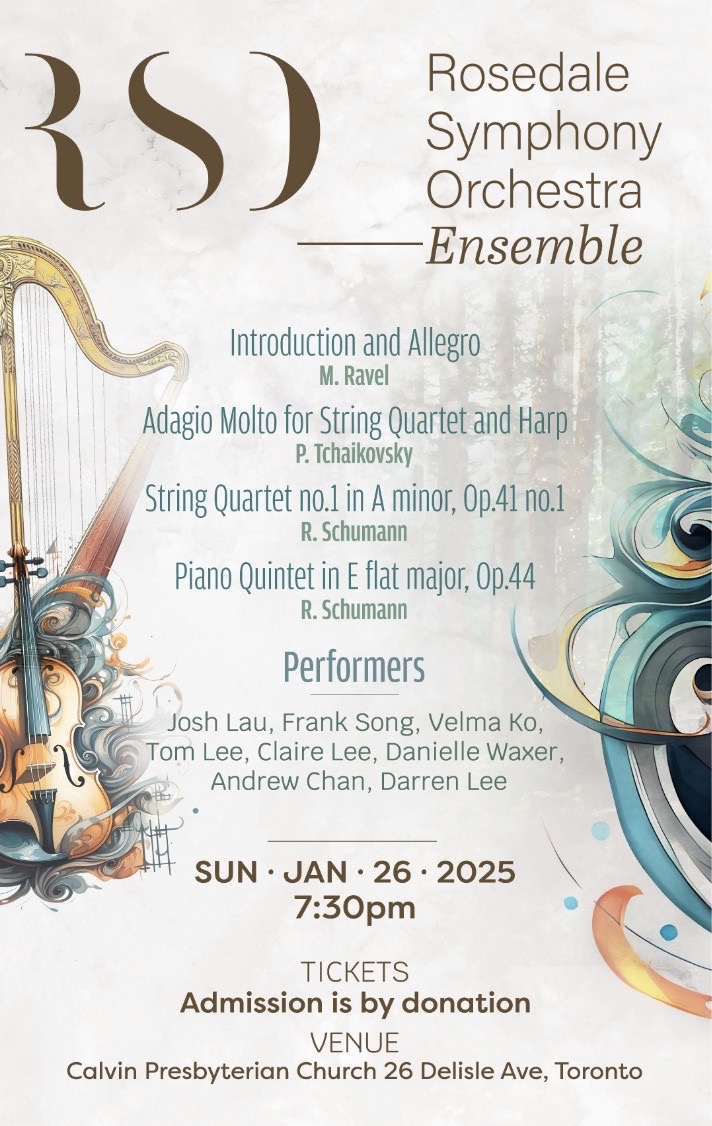
Program
Pyotr Tchaikovsky
(1840–1893)
Adagio Molto for String Quartet and Harp
An early work from 1863 or 1864 (although not published until 1967) written as an exercise while Tchaikovsky was a student at the Saint Petersburg Conservatory. After an opening for string quartet alone, the harp makes a striking appearance with a series of descending scale passages, only to disappear and reappear again briefly with the string quartet at the very end.
Robert Schumann
(1810–1856)
String Quartet no.1 in A minor Op.41 no.1
I.
Introduzione. Allegro espressivo - Allegro
II.
Scherzo. Presto - Intermezzo
III.
Adagio
IV.
Presto
In 1842, Schumann turned his manic focus to the string quartet and that was his “year of chamber music”. His string quartets represent a natural link between those of Mendelssohn and Brahms. The opening of the first quartet is slow and mournful and written in a contrapuntal style, representing a clear reference to Beethoven’s mystical late quartets. The first movement (Introduzione) contains multiple themes, a heightened development, and much imitative counterpoint, suggesting Schumann’s familiarity with Bach. The Scherzo that follows has some of Mendelssohn’s trademark sprightliness and some of Schubert’s galloping fervor. The Adagio is the centerpiece of the quartet with an overall mood of elegant and undulating melancholy. The finale Presto is full of bluster and celebration with textures that border on the orchestral, bringing the work to a fiery conclusion.
— Intermission (20 minutes) —
Maurice Ravel
(1875–1937)
Introduction and Allegro for harp, flute, clarinet, and strings
Commissioned to showcase the expressive range of the Érard double-action pedal harp, Ravel’s 1905 chamber work has a dazzling interplay of textures. The harp leads with shimmering arpeggios, while flute, clarinet, and strings weave impressionistic motifs that evoke water, wind, and light in motion. Ravel apparently wished to stress the privileged position of the harp and wanted the piece to be considered a miniature harp concerto as well as the original version as a septet.
Robert Schumann
(1810–1856)
Piano Quintet in E flat major Op.44
I.
Allegro brilliante
II.
In modo d'una marcia. Un poco largamente
III.
Scherzo: Molto vivace
IV.
Allegro ma non troppo
Bringing the piano and string quartet together, Schumann’s piano quintet exploits fully the expressive capacity of these forces. The quintet alternates conversational passages between the five instruments with concerto-like sections in which the combined forces of the strings are pitted against the piano. Much of the music from the first movement reappears in the subsequent movements. The piece beautifully contrasts the exuberance of Schumann’s brilliant, wild side with the slower sections of great passion. The second movement alternates the main theme (a funeral march) with a lyrical theme and a more agitated section led by the piano and accompanied by the strings. The third movement is lively and consists of many ascending and descending scales together with contrasting sections including a trio in a darker minor tonality with a flurry of sixteenth notes. The final movement is lively and makes much use of contrapuntal devices, including two notable fugato sections, one of which ingeniously combines the opening theme from the first movement with that of the final movement.
Venue
Calvin Presbyterian Church
26 Delisle Avenue, Toronto, Ontario