Mozart and Beyond
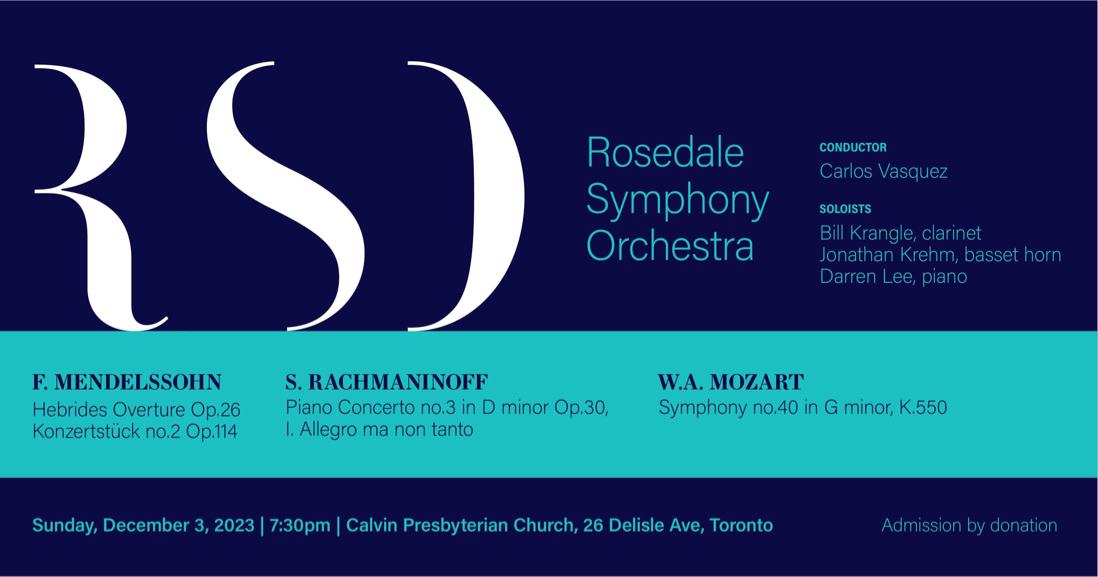
Conducted by:
Carlos Vasquez
Featuring:
Bill Krangle,
Clarinet · Jonathan Krehm,
Basset Horn · Darren Lee,
Piano
Program
Felix Mendelssohn
(1809–1847)
Hebrides Overture Op.26
One of Mendelssohn’s most famous and beloved works, the Hebrides Overture was inspired by a trip to the British Isles, specifically to the Scottish Island of Staffa, with its sea cave known as Fingal’s Cave (the alternative name for this work). This overture depicts a mood and sets a scene, making it an early example of a musical tone poem.
Felix Mendelssohn
(1809–1847)
Konzertstuck no.2 Op.114
Bill Krangle,
Clarinet
Jonathan Krehm, Basset Horn
Jonathan Krehm, Basset Horn
Written for originally for clarinet and basset horn with piano, it was subsequently orchestrated by Carl Baermann. The piece is structured in three short movements and is characterized by its melodic beauty, intricate harmonies, and virtuosic passages. Mendelssohn creates a sense of excitement through precise interweaving of melodies between the two solo instruments.
Sergei Rachmaninoff
(1873–1943)
Piano Concerto no.3 in D minor Op.30 (1st mvt)
I.
Allegro commodo
Darren Lee,
Piano
Made famous in the movie “Shine”, the “Rach 3” is known for its great beauty and its reputation for being one of the most technically challenging piano concertos in the standard repertoire. The first movement begins with a simple and sorrowful theme that returns on multiple occasions. It soon develops into busy piano figuration with much interplay with the orchestra. The movement reaches several ferocious climaxes, especially in the extended cadenza for solo piano, although it comes to a quiet end.
— Intermission (20 minutes) —
Wolfgang Amadeus Mozart
(1756–1791)
Symphony no.40 in G minor K.550
I.
Molto allegro
II.
Andante
III.
Menuetto. Allegretto - Trio
IV.
Finale. Allegro assai
This is sometimes referred to as the “Great G minor symphony” being one of only two minor key symphonies he wrote. The first movement begins in a dark manner and is soon followed with the famous theme that has a strong sense of urgency. That is followed by a contrasting lyrical second movement in a major key. The third movement is a minuet and begins with an angry, cross-accented hemiola rhythm; labeled as a “minuet”, the music would hardly be considered suitable for dancing. The finale opens with a series of rapidly ascending notes (outlining the G minor tonality) that conjure up the image of the compositional technique known as the “Mannheim Rocket”.
Venue
Calvin Presbyterian Church
26 Delisle Avenue, Toronto, Ontario