Pure Classics
Program
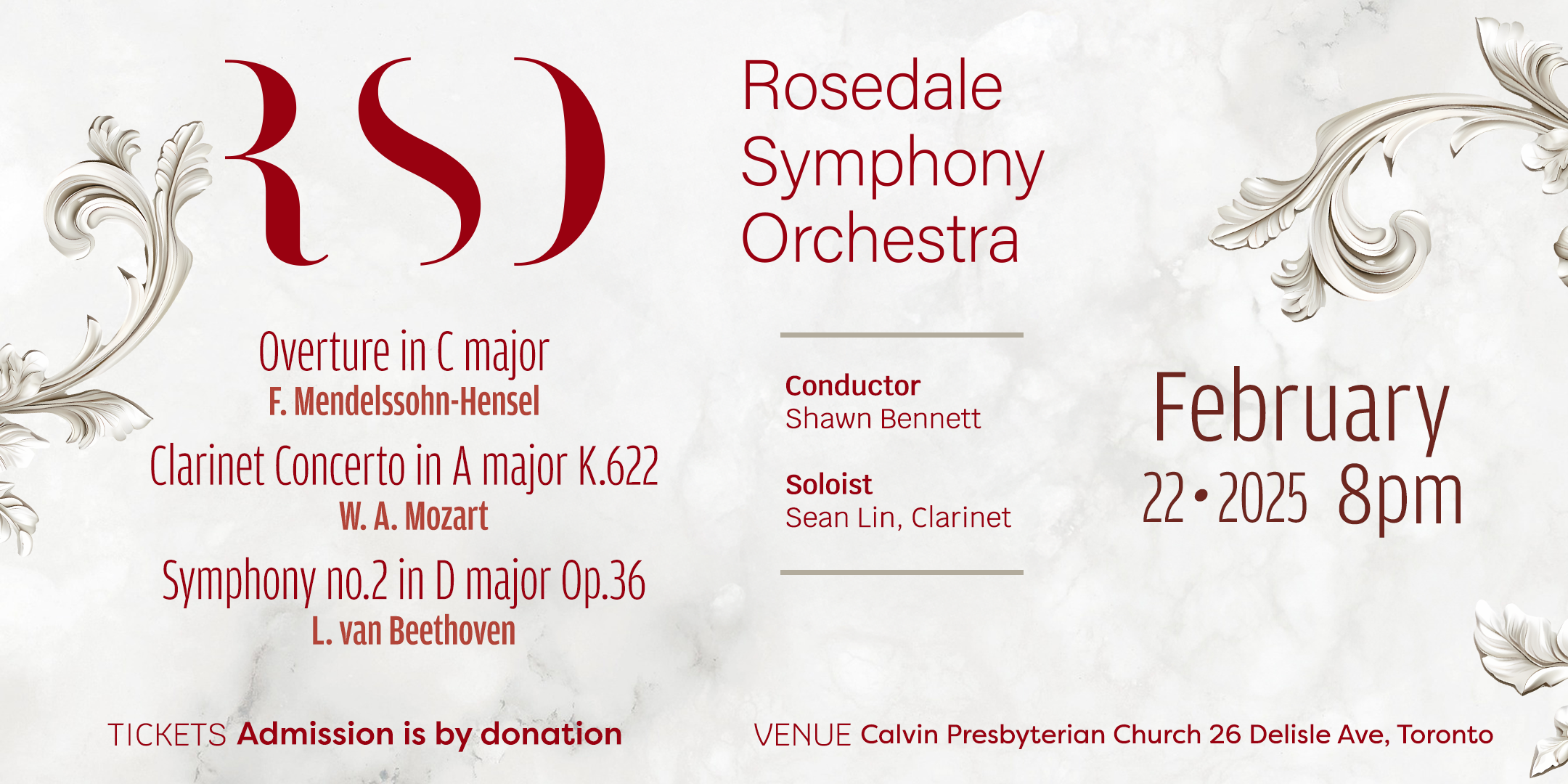
Fanny Mendelssohn-Hensel
(1805–1847)
Overture in C major
The Overture in C major is the only piece that Fanny Mendelssohn (the sister of Felix) wrote for orchestra alone. It features lyrical solos for the winds and brilliant writing for trings. The Overture begins with a slow introduction in the horns, strings, and woodwinds leading to a lively section with the main theme being shared throughout the orchestra. The winds reply to the string motif in a call and response, eventually leading to a charming wind interlude and pastoral string theme. The intensity continues to build through the bassoons and lower strings to the majestic call and response between trumpets and horns. The Overture ends with a playful variation of the theme which climbs to the final ringing chords across the orchestra
Wolfgang Amadeus Mozart
(1756–1791)
Clarinet Concerto in A major K.622
Sean Lin,
Clarinet
The Clarinet Concerto is one of Mozart’s final completed compositions and is characterized by mellowness and unassuming virtuosity. Instead of oboes, Mozart uses the clarinet, as well as flutes, bassoons and horns, while the deeper registers are supported by cellos and double basses. The opening movement is characterized by a main theme is so richly varied that it feels like a chain of related melodies. There is much exploitation of the solo clarinet’s vast range and colour. The slow movement, which is sublime in its simplicity and peacefulness, is followed by a finale that projects an air of gentle, slightly wistful contentment which is poignantly at odds with the composer’s physical state very shortly prior to his death.
— Intermission (20 minutes) —
Ludwig van Beethoven
(1770–1827)
Symphony no.2 in D major Op.36
Beethoven’s second symphony was primarily composed during his stay in Heiligenstadt in 1802, and is often overshadowed by the other symphonies. During this period, Beethoven’s hearing rapidly deteriorated, he was feeling increasingly isolated from society, and faced the threats posed by the politics of Napoleon. Nevertheless this work maintains a cheerful enthusiasm, demonstrating the composer’s strength and resolve to seize the day despite the many obstacles. The influence of Napoleon could be heard in the use of massive orchestral forces, a quality of grandeur and potency, and even some occasional references to military rhythms and instruments. Beethoven relies largely on the juxtaposition of extremes and surprises to evolve the language of the symphony.
Extremes of dynamics, sudden and powerful silences, new orchestral colours, harmonic surprises and modal shifts are prevalent in the first movement. The second movement is one of Beethoven’s longest symphonic slow movements with clear indications of the influence of folk music and the pastoral. In the third movement, he notably replaces the standard minuet with a scherzo, which provides greater scope and energy. The finale is energetic and frantic, full of Beethovenian jokes and a sense of joie de vivre. The symphony concludes with an extended coda providing a balance with the large scope of the opening movement.
Extremes of dynamics, sudden and powerful silences, new orchestral colours, harmonic surprises and modal shifts are prevalent in the first movement. The second movement is one of Beethoven’s longest symphonic slow movements with clear indications of the influence of folk music and the pastoral. In the third movement, he notably replaces the standard minuet with a scherzo, which provides greater scope and energy. The finale is energetic and frantic, full of Beethovenian jokes and a sense of joie de vivre. The symphony concludes with an extended coda providing a balance with the large scope of the opening movement.
Venue
Calvin Presbyterian Church
26 Delisle Avenue, Toronto, Ontario