Darkness and Light
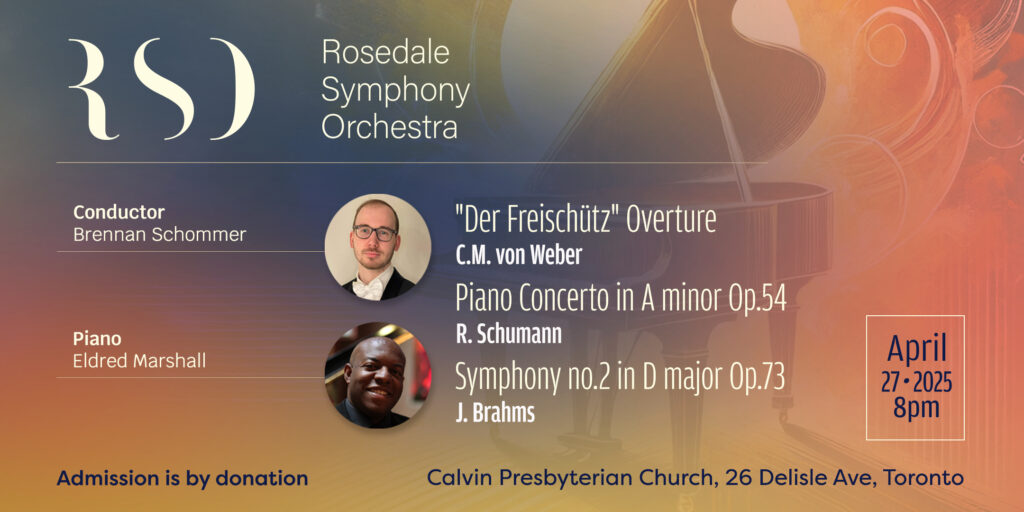
Program
Carl Maria von Weber
(1786–1826)
Der Freischütz Overture
Premiered in 1821, Carl Maria von Weber’s Der Freischütz (The Marksman) marked a turning point in German opera, fusing folklore, nature, and the supernatural into a dramatic new musical language. The overture sets the tone for the opera’s world of dark forests and ghostly forces. Its ominous introduction evokes the tale’s central conflict – between innocence and temptation – before giving way to more lyrical and pastoral themes. Weber’s orchestration is vivid and theatrical, filled with shifting moods and bold dynamic contrasts. The horn calls and hunting rhythms suggest the opera’s rustic setting, while sudden outbursts hint at the supernatural forces lurking beneath. The overture’s dramatic arc, from darkness to resolution, stands as a powerful prelude to the opera and a touchstone of early Romanticism.
Robert Schumann
(1810–1856)
Piano Concerto in A minor Op.54
I.
Allegro affettuoso
II.
Intermezzo
III.
Allegro vivace
Eidred Marshall,
Piano
Schumann wrote his only piano concerto originally as a one-movement fantasy for piano and orchestra. Upon the urging of his wife Clara, a famous and revered pianist, he added the remaining two movements to complete the work as we know it today. The first movement opens with a bold piano gesture, leading into a thematic world rich in warmth and introspection. The second movement, marked “Intermezzo”, offers a delicate contrast – tender, songlike, and quietly intimate. The finale brings a buoyant energy, with rhythmic play and spirited exchanges. The concerto’s unity of mood and motivic development reflect Schumann’s gift for narrative coherence, while its poetic character makes it one of the Romantic era’s most beloved works for piano and orchestra.
— Intermission (20 minutes) —
Johannes Brahms
(1833–1897)
Symphony no.2 in D major Op.73
I.
Allegro non troppo
II.
Adagio non troppo
III.
Allegretto grazioso
IV.
Allegro con spirito
Composed during the summer of 1877 in the lakeside town of Pörtschach, Brahms’ Second Symphony stands as one of his most radiant and lyrical orchestral works. The symphony unfolds with a sense of natural ease and melodic abundance, often likened to the pastoral serenity of the countryside. The first movement flows gently but with underlying complexity, while the second offers rich harmonic shading and introspection. The third, a graceful Allegretto, brings lightness and charm, before the finale bursts forth with exuberant energy. Yet even amid its warm and optimism, the symphony contains shadows – Brahms’ signature depth never far from the surface.
Venue
Calvin Presbyterian Church
26 Delisle, Toronto, Ontario