Mozart and Friends
Program
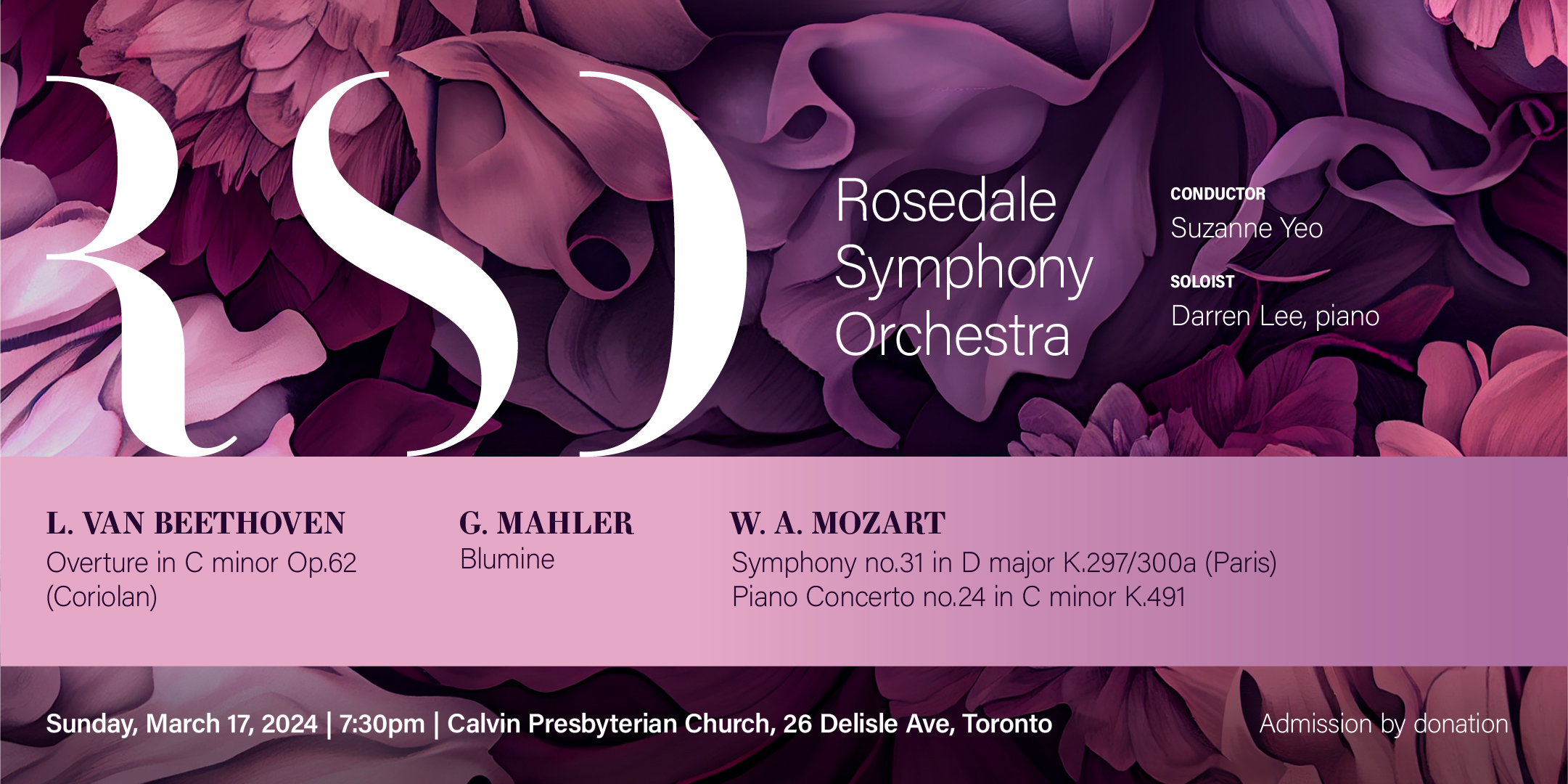
Ludwig van Beethoven
(1770–1827)
Coriolan Overture Op.62
Beethoven recreates Shakespeare’s story of the Roman general and his contempt for the plebeians of Rome. Coriolanus joins the enemy side, the Volscians, whom he leads in battle against Rome. His mother begs her son to make his peace with Rome. The first theme is in C minor and shows Coriolanus’ rebellious nature and the second theme is gentler and is associated with his mother. She eventually seems to win her son over but then the C minor theme returns, with less conviction and the music essentially falls apart, as does Coriolanus, whose only possible fate is death.
Wolfgang Amadeus Mozart
(1756–1791)
Piano Concerto no.24 in C minor K.491
I.
Allegro (candenza: J. Hummel)
II.
Larghetto
III.
Allegretto
Darren Lee,
Piano
This work features the largest array of instruments in all of Mozart’s piano concertos. Notable is the expanded role of the wind instruments which function as dramatic personas in their own right. The opening movement is full of tragedy and the second movement provides some relief with a series of child-like themes. The finale is a theme and variations with much activity for the woodwinds and virtuosic passages for the piano that are figurative and contrapuntal in nature. It has been said that the concerto may have served as an outlet for a darker aspect of his creativity at the time he was composing The Marriage of Figaro.
— Intermission (20 minutes) —
Gustav Mahler
(1860–1911)
Blumine
Literally translated as “flower piece”, Blumine was originally included Mahler’s first symphony. The piece is rather uncharacteristic of Mahler and is best described in the following quote by Mahler’s most distinguished biographer as “pretty, charming, lightweight, urbane, and repetitious, just what Mahler’s music never is.”
Wolfgang Amadeus Mozart
(1756–1791)
Symphony no.31 in D major K.297/300a
I.
Allegro assai
II.
Andante
III.
Allegro
This is better known as the “Paris symphony”, composed during his unsuccessful job hunting sojourn in Paris. The first movement is grand and thrilling with an outpouring of breathless musical ideas followed by a gentle and graceful middle movement. The last movement effectively utilizes loud vs. soft effects, fugal counterpoint, and full orchestral sound. Overall, Mozart aimed to create a crowd-pleasing finale while maintaining a sophisticated blend of musical ideas.
Venue
Calvin Presbyterian Church
26 Delisle Avenue, Toronto, Ontario