Debut Concert - Beethoven, Brahms, Mozart
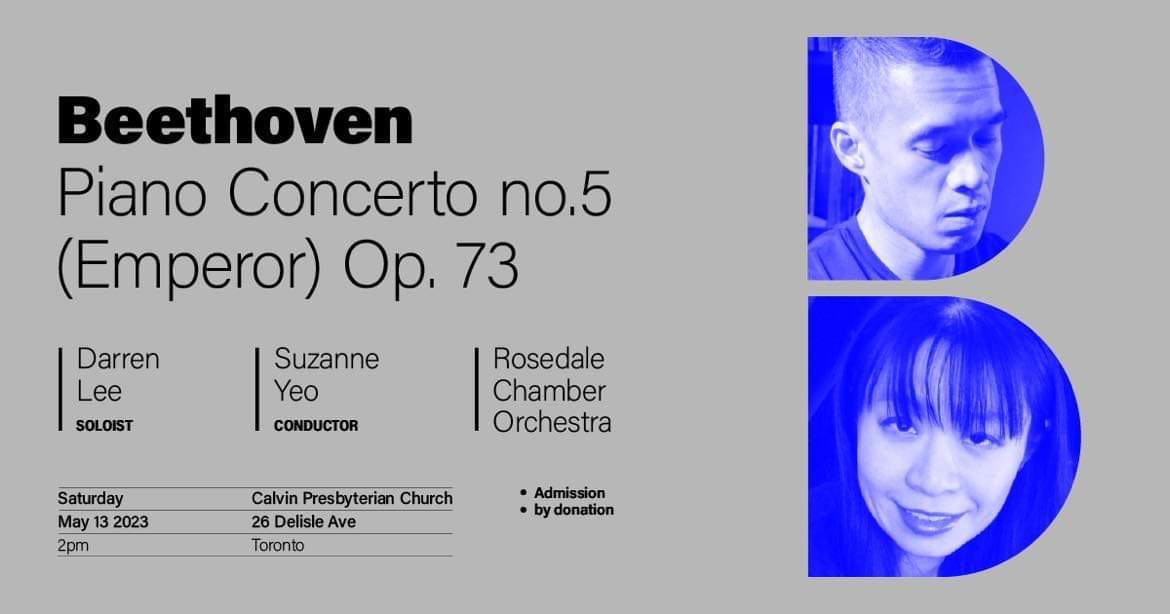
Conducted by:
Suzanne Yeo
Featuring:
Darren Lee,
Piano · Chris Buchner,
French Horn · Darren Lee,
Piano · Qian Li,
Violin · Claire Lee,
Flute · Velma Ko,
Viola · Amit Rotem,
Cello
Program
Johannes Brahms
(1833–1897)
Horn Trio Op.40 (1st mvt)
I.
Andante
Chris Buchner,
French Horn
Darren Lee, Piano
Darren Lee, Piano
Written in commemoration of the death of his mother, the Horn Trio generally evokes a somber and melancholic mood, especially in the opening movement performed today. Brahms stated that the simplicity of the opening theme came to him while he was walking through the woods. The movement is structured in three slow sections offset by two shorter, more rhapsodic segments. There is a dramatic climax near the end followed by a quiet close.
Wolfgang Amadeus Mozart
(1756–1791)
Flute Quartet no.1 in D major K.285
I.
Allegro
II.
Adagio
III.
Rondeau
Qian Li,
Violin
Claire Lee, Flute
Velma Ko, Viola
Amit Rotem, Cello
Claire Lee, Flute
Velma Ko, Viola
Amit Rotem, Cello
Written for flute, violin, viola, and cello, it is the first of three quartets. The first movement is written in concertant style, which predates the “concerto” form that features a single instrument at the highest level of skill and display. The second movement is a serenade where the strings create a textural contrast between their pizzicato figures and the flute’s long sustained melodies. The finale passes the melody across the group in pairs and ornamented versions to showcase the virtuosity of the group as a whole.
— Intermission (20 minutes) —
Ludwig van Beethoven
(1770–1827)
Piano Concerto no.5 in E flat major Op.73 (Emperor)
I.
Allegro
II.
Adagio un poco mosso
III.
Rondo: Allegro
Darren Lee,
Piano
Famously known as the Emperor Concerto, it has a heroic style and was composed on a grand scale, typical of Beethoven’s works during his middle period. Here he experiments with new techniques such as the piano entrance beginning earlier than typical and with an extended piano solo consisting of flourishes of trills and scales after chords performed by the orchestra. The second movement is a quiet nocturne for the piano, muted strings, and wind instruments that evokes a spiritual and meditative mood. The music moves seamlessly into a joyous finale where the piano introduces the galloping main theme that reappears throughout in various guises.
Venue
Calvin Presbyterian Church
26 Delisle, Toronto, Ontario